
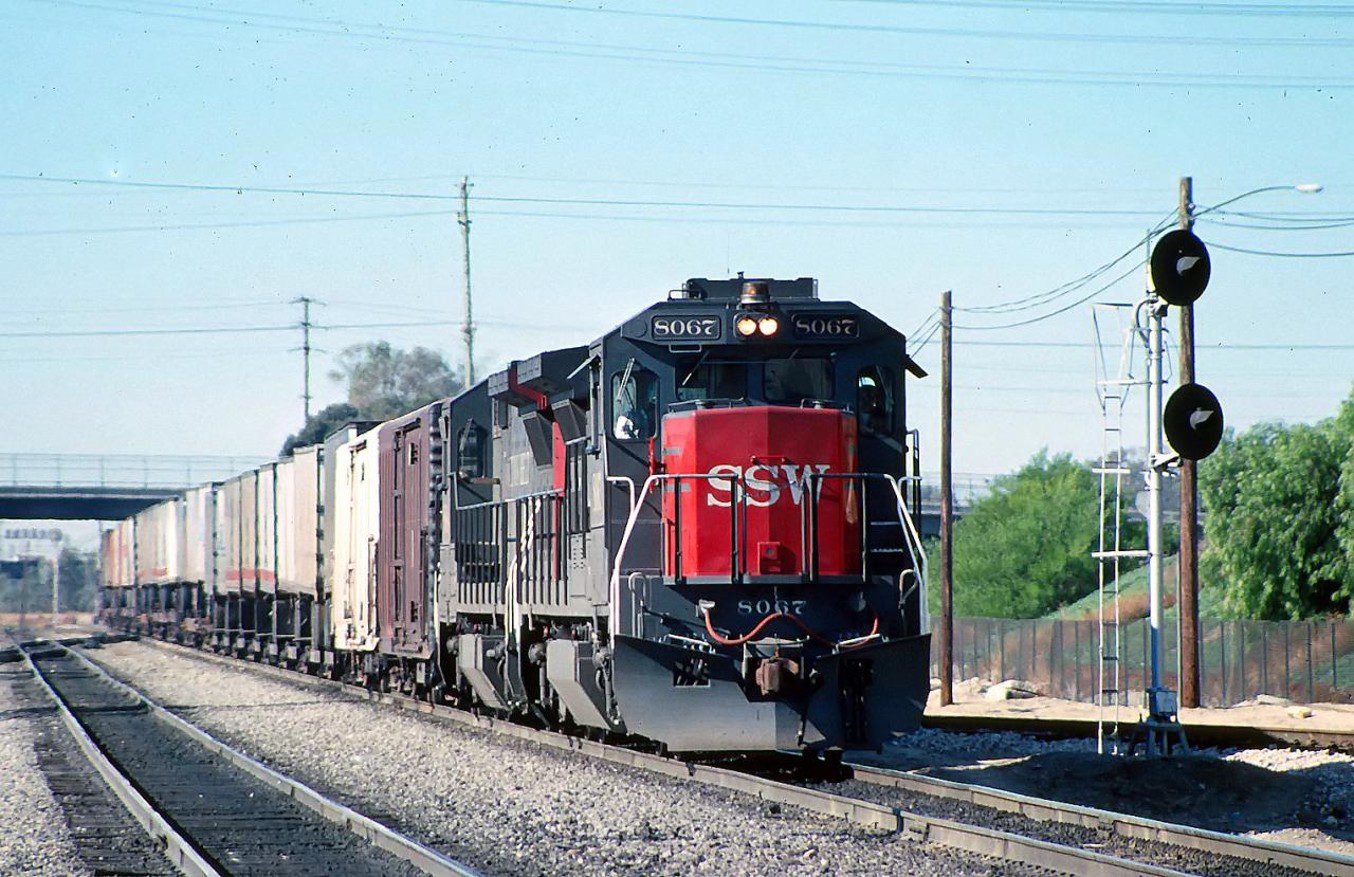
In American railroading, “frog wars” occurred when one railroad company attempted to cross another company’s tracks. The disputes often ended up in court and sometimes led to tense confrontations. The term comes from the “frog,” the section of track that allows two rail lines to cross or merge at a junction or railroad switch.
Colton Crossing was built in 1883 and became the site of one of the most significant frog wars in railroad history. In 1875, the Southern Pacific Railroad decided to construct a transcontinental line east from Los Angeles through the San Gorgonio Pass and into the San Bernardino Valley.
Southern Pacific demanded $100,000 in concessions from San Bernardino, but civic and business leaders refused. As a result, the railroad bypassed San Bernardino by four miles to the south through what would later become Colton.
A few years later, the California Southern Railroad planned to build a rail line north from San Diego through San Bernardino. Southern Pacific refused to allow construction of the necessary crossing at Colton and positioned locomotives on its tracks to block the work.
California Southern filed a lawsuit and won a court order requiring the crossing to be built. Southern Pacific, however, continued to delay construction.
In September 1883, supporters of both railroads gathered near the crossing site as tensions escalated. Legendary lawman Virgil Earp was hired as a special agent to protect Southern Pacific’s interests and remained aboard a locomotive blocking the crossing. Many of those gathered carried tools and firearms as the standoff continued.
Future California Gov. Robert Waterman directed San Bernardino County Sheriff J.B. Burkhart to enforce the court order. Burkhart appointed 10 men and accompanied Waterman to the crossing site where the court order was read. Earp then ordered the engineer to move the locomotive to clear the way for construction. San Bernardino citizens cheered as work on the crossing began.
The crossing was completed and the first California Southern train arrived in San Bernardino on Sept. 13, 1883.
The information in this historical feature was originally part of a video series produced by the Assessor-Recorder-County Clerk’s office.
Additional County Update News – August 6, 2026
- Board actions, Aug. 4
- SPARK closing ceremony celebrates growth, opportunity and the future of public service
- 2026 State of the County to spotlight businesses and celebrate 100th anniversary of Route 66
- Residents find relief and hope after county purchases supportive housing community
- Cards and letters for Jackie continue to arrive at Station 96
- Behind the Ready: Meet the People Supporting Emergency Management
- Office of Emergency Services seeks public input on Hazard Mitigation Plan
- Human Resources earns five 2026 NACo Achievement Awards
- County Library expands online learning resources with Homework CA
- SBC Through Your Eyes: Sky High Trail
- Submit your photos and videos of the county’s destinations, nature and cityscapes
- Things to do in San Bernardino County
- Pet of the Week: Daisy