
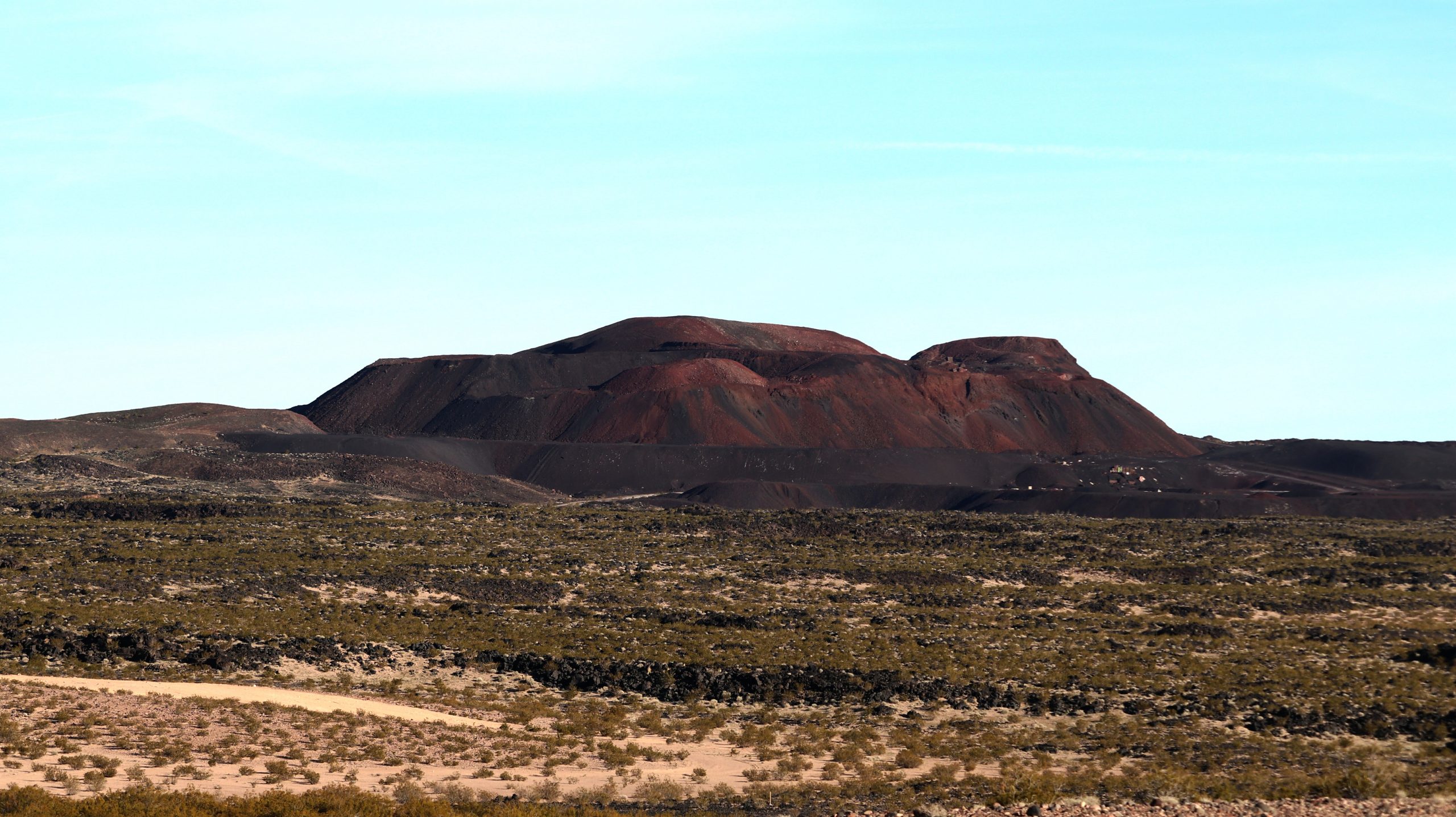
Today, travelers driving along Interstate 40 across the Mojave Desert may notice a series of peculiar features on the horizon. This includes conical mounds of red and black volcanic rocks rising abruptly from the desert floor.
The region’s volcanic history dates back millions of years ago when extensive tectonic activity in western North America resulted in a dynamic period of volcanism.
Over time, major fault systems continued to develop across what is now California, which created many volcanoes throughout the region. Fountains of molten magma erupted through vents in the Earth’s crust beneath present day sections of the Mojave Desert.
Between Barstow and Ludlow sits the Lavic Lake volcanic field, which has four cinder cone volcanoes. Three are located near Lavic Dry Lake while the fourth is located southwest in the Rodman Mountains.
These volcanoes began forming long ago. It is estimated that lava continued flowing in this region until thousands of years ago. In 1919, some miners reported seeing black smoke rising from one of the cinder cones, which prompted a sheriff’s investigation. Officials ultimately determined that the cinder cone was still extinct.
Of the four cinder cones, Pisgah cinder cone stands as the most accessible and prominent. It rises about 330 feet above the field with a peak elevation of 2,545 feet. For more information, visit volcanoes.usgs.gov.
The information in this historical feature was originally part of a video series produced by the Assessor-Recorder-County Clerk’s office.
Additional County Update News – July 9, 2026
- San Bernardino County releases 2026 assessment roll with total assessed value reaching $376.9 billion
- San Bernardino County Office of Emergency Services seeks public input for the 2027 Hazard Mitigation Plan update
- County Fire rises to the occasion
- Simple steps for a mosquito-safe summer
- Protecting Pioneertown’s character through community collaboration
- From uncertainty to opportunity: A foster youth finds a trusted support system with Children and Family Services
- Children’s Network hosts first Safe Beginnings Summit to strengthen infant and family safety across San Bernardino County
- Animal Care is seeking short-term foster families to support upcoming Wings of Rescue flight
- QPR in Spanish: Training that saves lives
- Explore county careers with SBC LevelUP
- SBC Through Your Eyes: Bluff Lake Reserve
- Submit your photos and videos of the county’s destinations, nature and cityscapes
- Things to do in San Bernardino County
- Pet of the Week: Sandy